
Every fibre programme runs on information. Which streets are permitted, which gangs are where, what was built yesterday, what passed QA, what is ready to bill and what the subcontractor is owed. On most programmes that information lives in a dozen places: spreadsheets, a monday.com board or two, WhatsApp groups, email chains and somebody's notebook. Every handover between them is a chance for a toby to be missed, a snag to go unfixed or an invoice to be raised a month late.
We decided to stop living with that. Since June, we have built the Hub: our own delivery platform, used every day by our project managers, coordinators, gang leaders, build partners and finance team. This is the story of how it came together.
Why build our own? We looked at what was on the market. Generic project tools didn't understand a fibre build: no footways, no tobies, no OF runs, no permit states. Specialist systems were built for the network operator, not for the contractor in the middle who has to answer to the client and pay the build partners. And none of them could be changed the week we found a better way of working.
So we set ourselves one rule: the system has to follow the job the way our teams actually do it. If a coordinator works permits street by street, the permit board is street by street. If Grain walks off a footway before it can be billed, nothing becomes billable until the walk-off has passed.
Months of work, more than 700 releases The Hub went live in June. Since then it has had more than 700 releases. That isn't a typo. Most weeks, something our teams asked for on Monday was on the staging site by Tuesday and live by Wednesday.
It grew the way the programme grew:
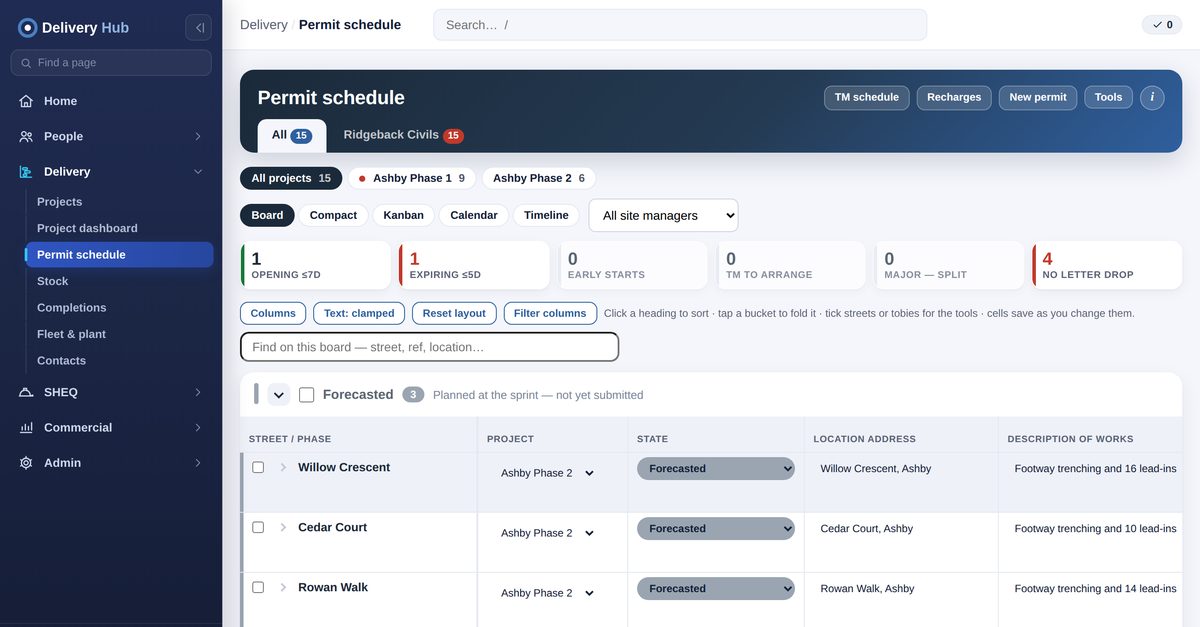
Costing and rate cards first: customer rates, subcontractor rates and the margin between them, before a spade goes in. Then the field: daily reports from a phone, offline if the signal drops, with metres, tobies, materials, delays and photos. Then permits: a live board for every street, from forecast to handover, with TM, TTRN and TTRO booked straight from the row. Then quality: internal and client QA on every toby, snag reports pushed to the build partner with a due date, and the street moving back for review when the last snag is fixed. Then the money: applications for payment built only from work that has passed, handover acceptance certificates checked against the PO, and subcontractor invoices checked against the agreed rates automatically. And everything around it: stock, fleet, SHEQ, POWRAs, site instructions, recharges, a client portal and a weekly review that writes its own minutes. The permit schedule: every street grouped by its permit state, from forecast to handover (demo programme, sample data)
Today the Hub has around 60 users, five roles that each see only what they should, and a client portal where our customer sees progress, walk-offs and snags, never a cost. One by one we have switched off the monday.com boards it replaced.
Completions: every footway with its tobies, walk-off date and result, and what is ready to bill (demo programme, sample data)
Built with Claude Code None of this would have been possible at this pace with a traditional development team. The Hub has been built with Claude Code, Anthropic's AI coding assistant, working alongside the two of us.
What made it work wasn't the AI on its own. It was the discipline around it:
Every change is tested. The Hub has around 100 automated test suites, run against both of the databases it supports, on every single change. A change that breaks something doesn't get merged. Staging before live. Everything is seen working on a separate staging Hub before it reaches the team. The people who do the job decide what gets built. Claude Code writes the software; it doesn't decide what the software should do. The project dashboard: built and passed against the plan, and the forecast finish at the current pace (demo programme, sample data)
Lee and Paul Between us, we brought the two halves the system needed.
Leelin Ludick, our Delivery Manager, brought the programme: how permits really move, what a coordinator needs at 7am, what Grain looks for at a walk-off, where the paperwork goes wrong. Much of the Hub exists because Lee walked through a process, said "this is how it should work", and kept testing it until it did.
Paul Johnson, our CEO, brought the commercial and financial side, from rate cards and margins to the payment flows between client, Coreline and build partners, and drove the build itself, release by release.
The result is a platform built by the people who run the work, for the people who do it.
Safe, secure and backed up A system that runs a live programme has to be trusted with three things: the people on site, the data, and the evidence.
Safety on site. SHEQ runs through the Hub rather than beside it. Every crew completes a POWRA on their phone before work starts, and a "no" on a critical check, such as signing, lighting and guarding, PPE or keeping the non-working side clear, stops the job and alerts SHEQ. The training matrix shows who is competent for what, SiteReady puts a short site test in front of every operative each week, and incidents, near misses and site observations are logged, tracked and closed out.
Security. Every user signs in with two-factor authentication. Each of the five roles sees only what it should: a subcontractor never sees our client's rates or another subcontractor's work, our client never sees a cost, and field operatives never see money at all. Repeated failed sign-ins lock an account, and every change to a project, a rate or a user is recorded in an audit trail.
Backups and evidence. Every photo and document is copied offsite every night. Delivery evidence, the daily report photos taken on site and each project's documents, is also filed automatically into our own SharePoint, street by street and day by day. So the evidence a client needs at handover sits in our document library as well as in the Hub, long after the job is done.
What it means for our clients For a client, the Hub means one version of the truth. Progress is live, not a spreadsheet emailed on a Friday. Evidence is captured on the day, so handover packs are built as the work is done, not chased at the end. Applications for payment are backed by walk-off evidence, so they are cleaner and faster to approve. And our build partners work to our standard because they work in our system.
The client portal: progress, walk-offs and snags for the customer, and never a cost (demo programme, sample data)
What's next We're still building. Every week the team finds something that could be quicker, clearer or safer, and every week the Hub gets a little better.
If you're running a fibre programme and want to see what that looks like in practice, get in touch.